What Grows in the Dark: The Laboratory Conditions That Shape an Embryo's First Five Days
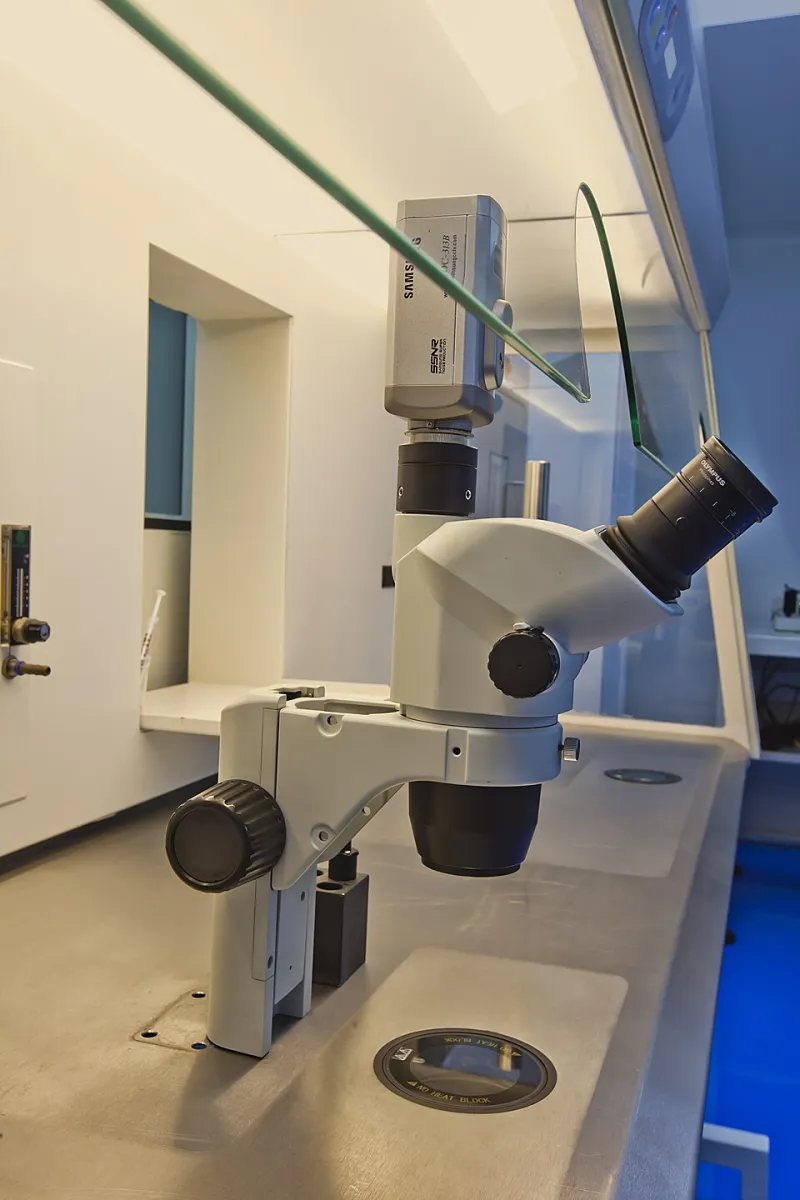
Photo: Dr.jayesh amin, CC BY-SA 3.0, via Wikimedia Commons
An embryo created in a laboratory spends five to six days inside a system engineered to resemble a fallopian tube — one that has never quite succeeded. It is not a dramatic environment. It is warm, dark, and chemically controlled, and nearly everything in it, from the salts in the dish to the air moving past the incubator door, is a decision made by someone the patient will probably never meet.
That is IVF's quiet asymmetry. Patients can recite their AMH, their antral follicle count, their protocol, and the exact minute of their trigger. Far fewer can say anything about the medium their embryos were cultured in, the oxygen concentration of the incubator, or whether the laboratory's air handling was re-validated after the building's flooring was replaced. None of it appears in a portal. All of it is part of the recipe.
The dish is a formulated product, not a blank slate
Culture media are often described as simulated tubal fluid, a phrase that understates how much chemistry is involved. A typical formulation includes inorganic salts to hold pH and osmolality in range, energy substrates such as pyruvate and lactate, a defined amino acid mixture, a protein supplement — most often human serum albumin — and frequently a small amount of antibiotic. Some laboratories culture in a single medium throughout; others switch to a second formulation designed for the metabolic shift between the cleavage and blastocyst stages.
Every component arrives with a lot number. Manufacturers generally release lots after a mouse embryo assay, a sperm survival test, endotoxin screening, and verification of pH and osmolality. Laboratories are then expected to verify lots on arrival rather than treating the certificate of analysis as the last word.
Patients rarely hear any of this, but it is one of the more legible quality signals available. A laboratory that can describe its lot-testing routine in plain language is usually a laboratory with a routine worth describing.
Air is an ingredient nobody lists
Volatile organic compounds are the least intuitive variable in the room. They off-gas from paint, adhesives, vinyl flooring, cleaning agents, printer toner, and even the perfumes and hand lotions staff carry through the door. Because embryos sit in minute droplets beneath an oil overlay, and because many of these compounds are lipid-soluble, airborne contaminants can partition into the oil and reach the embryo from below as well as above.
Well-designed laboratories respond architecturally: dedicated air handling with HEPA filtration and carbon or potassium permanganate filters, positive pressure relative to surrounding corridors, restricted foot traffic, no-scent policies, and a standing rule that renovations happen far from the culture room or not at all.
The incubator is a microclimate with a maintenance log
Inside the incubator, three variables do most of the work: temperature near 37 degrees Celsius, carbon dioxide around 5 to 6 percent to hold pH, and oxygen — either atmospheric at roughly 20 percent or reduced to about 5 percent. Laboratory evidence has generally favored reduced oxygen for blastocyst development, and many US programs have moved in that direction, though practice is not uniform.
Each time an incubator door opens, that microclimate shifts. This is the logic behind benchtop incubators with individually gassed chambers and behind time-lapse systems that keep embryos undisturbed behind a camera. The trade-off is more instrumentation to calibrate, clean, and monitor — which is itself a staffing question.
What accreditation actually certifies
Most US fertility laboratories hold CLIA certification, and many pursue accreditation through the College of American Pathologists or The Joint Commission, alongside FDA registration as a tissue establishment and voluntary membership in SART. These processes review documentation, personnel competency, equipment logs, and quality control records. They are meaningful. They are also periodic and process-oriented: no accreditor publishes a clinic's volatile organic compound readings or its blastocyst rate stratified by maternal age.
That gap is not a scandal. It is simply the difference between verifying that a system exists and proving that the system is producing superior results.
Questions worth asking
- Which culture system do you use, and how do you verify each new lot?
- Do you culture at reduced oxygen, and in what type of incubator?
- How is the laboratory's air handled, and when was the filtration last validated?
- How often are incubators opened during the day, and do you use time-lapse?
- What is your blastocyst formation rate for patients in my age range?
Less useful: requests for raw quality-control spreadsheets, or treating a warm, detailed answer as proof of quality. A clinic can be generous with information and still be perfectly average.
The question behind the question
There is no consumer-side test for laboratory quality, and patients should be skeptical of anyone who claims to offer one. What can reasonably be evaluated is whether a laboratory has a system for noticing when something drifts — a failing lot, a contaminated incubator, a filtration unit past its change date. The productive question is not whether the lab is clean. It is how the lab would know if it were not.